Starting strength training with dumbbells does not need to feel complicated. You do not need dozens of exercises, a perfectly organized home gym, or years of lifting experience before you can put together a workout that helps you get stronger.
For most beginners, the real challenge is knowing where to start. Which exercises should you choose? How heavy should the dumbbells be? How many sets and reps should you do? And how do you know when it is time to increase the weight?
A good dumbbell workout for beginners answers those questions without giving you more complexity than you need. The goal is to learn a few useful movement patterns, choose resistance you can control, train consistently, and gradually make the exercises more challenging as your strength improves.
This guide walks through the best dumbbell exercises for beginners, how to choose your starting weight, how many sets and reps to perform, how often to train, how to progress, and how to put everything together into a practical full body routine.
What Dumbbell Exercises Are Best for Beginners?
The best dumbbell exercises for beginners are not necessarily the ones that look the most advanced or target every individual muscle. A better starting point is to choose a small group of movements that teach the basic patterns you will continue using as you become stronger.
For most beginners, that means including a squat, a hip hinge, an upper body push, an upper body pull, and one or two additional movements such as a shoulder press or single leg exercise.
A practical beginner exercise list could include:
- Goblet squat: Trains the legs and glutes while introducing resistance to the squat pattern
- Dumbbell hip hinge or Romanian deadlift progression: Trains the hamstrings and glutes while teaching you to move from the hips
- Dumbbell chest press or floor press: Trains the chest, shoulders, and triceps
- Supported one arm dumbbell row: Trains the back and arms while giving you a stable position to work from
- Dumbbell shoulder press: Trains the shoulders and triceps
- Reverse lunge or split squat: Adds single leg strength, balance, and lower body control
A goblet squat is a useful place to begin because holding one dumbbell in front of your body gives you a straightforward way to add resistance without making the movement unnecessarily complicated. If adding weight makes the squat difficult to control, start with bodyweight first and introduce the dumbbell once the movement feels more comfortable.
For upper body pushing, a dumbbell chest press or floor press gives you a stable way to train the chest, shoulders, and triceps. Early on, your priority should be controlling the dumbbells through the movement rather than testing how much weight you can lift.
Rows are equally important because they balance the pressing work in your routine. A supported one arm dumbbell row can be especially useful for beginners because you can brace with your free hand while focusing on pulling the weight without twisting your torso or using momentum.
A dumbbell shoulder press can also fit well into the routine, but this is one movement where starting lighter usually makes sense. When the weight becomes too heavy, it is easy to lean backward or turn the exercise into more of a full body effort than an actual shoulder press.
The hip hinge often takes a little more practice. Dumbbell Romanian deadlifts can be effective for the hamstrings and glutes, but beginners should first learn how to push the hips backward while keeping the movement controlled. Practicing the hinge with little or no weight before gradually adding dumbbells can make the exercise much easier to learn.
Single leg movements such as reverse lunges or split squats can also be useful, although balance may become the limiting factor before leg strength does. If that happens, start with bodyweight or very light dumbbells and add resistance only when the movement feels stable.
You do not need a different exercise for every muscle group. A few well chosen compound movements can train a large portion of the body while making it much easier to learn the exercises, track your progress, and build confidence with the routine.
How Heavy Should Dumbbells Be for a Beginner?
There is no single dumbbell weight that every beginner should use because the right amount of resistance depends on your current strength, the exercise you are doing, and how many repetitions you plan to perform.
Instead of starting with a specific number of pounds, choose a dumbbell you can control throughout the full movement. The weight should feel progressively more challenging as the set continues, but it should not force you to shorten your range of motion, swing the dumbbells, twist your body, or change your technique just to finish the repetitions.
If you are aiming for around 8 to 12 reps, a simple test is:
- If you cannot reach 8 reps with good technique, go lighter.
- If you can complete 8 to 12 reps and the final few feel challenging while your form stays controlled, the weight is probably appropriate.
- If you reach 12 reps easily and feel like you could keep going for many more, consider moving slightly heavier.
The last few repetitions should require effort, but they do not need to become an all out struggle. You should still be able to control the lowering phase and maintain roughly the same movement pattern you used at the beginning of the set.
You should also expect to use different weights for different exercises. Your legs and back can often handle more resistance than your shoulders or smaller upper body muscles, which means the dumbbell you use for a goblet squat or row may be heavier than the one you use for a shoulder press.
That is why asking, “What weight dumbbells should a beginner buy?†does not always have one simple answer. A single pair may work well for one movement and feel completely wrong for another, which is where adjustable dumbbells or access to several weight options can be useful.
When you are learning a new exercise, starting lighter is usually the better choice. Your first goal is to learn the movement well enough that you can repeat it consistently. Once that happens, you can gradually increase the resistance.
How Many Sets and Reps Should Beginners Do With Dumbbells?
For most beginners, 2 to 3 working sets of around 8 to 12 repetitions per exercise is a practical starting point, but those numbers are better viewed as a framework than a rule.
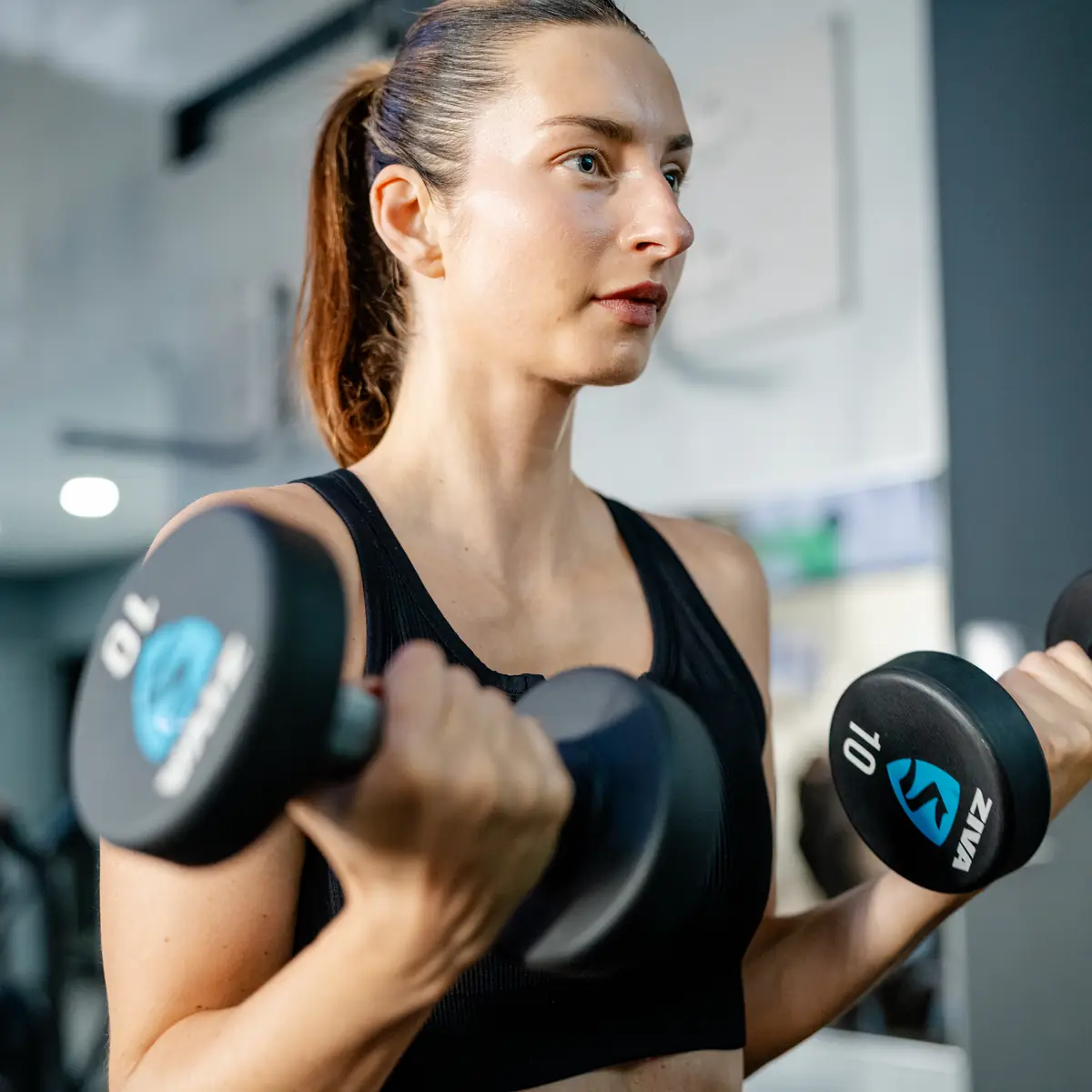
Different exercises can feel very different even when they use the same rep target. A goblet squat may allow more weight than a shoulder press, while a reverse lunge may become challenging because of balance before muscular strength becomes the limiting factor.
The goal is to choose a repetition range that allows you to work hard while still controlling the exercise.
A simple way to judge the weight is:
- If you cannot reach the bottom of the rep range with good technique, use a lighter dumbbell.
- If you can complete the target reps and the final few feel challenging, the resistance is probably appropriate.
- If you reach the top of the range easily and could continue well beyond it, consider increasing the weight.
If you are completely new to strength training, starting with two sets can be enough while you learn the movements. Once the exercises feel more familiar and your recovery is good, adding a third set can increase the amount of work without changing the entire routine.
Beginners also do not need to take every set to failure. Your final repetitions should require effort, but stopping while you can still maintain good technique is usually more productive than forcing every set until another rep is impossible.
Rest matters too. Around 60 to 90 seconds between sets may work well for many beginner exercises, but the clock does not need to control the workout. If a challenging set of squats or rows leaves you too fatigued to perform the next set properly, taking a little more time can help you maintain better quality.
Instead of worrying about whether every exercise is exactly three sets of 10, pay attention to whether you are becoming more capable over time.
How Often Should Beginners Do Dumbbell Workouts?
For most beginners, 2 to 3 full body dumbbell workouts per week is a practical starting point.
That schedule gives you enough opportunities to practice the main movements and build strength while still leaving room to recover between sessions.
A simple week could look like:
- Monday: Full body dumbbell workout
- Wednesday: Full body dumbbell workout
- Friday: Full body dumbbell workout
If three sessions feels like too much at first, two workouts can still be productive. You might train on Monday and Thursday, for example, and use the days between them for walking, mobility, cardio, or recovery.
Full body training is usually easier for beginners to organize than splitting the week into separate chest, back, shoulder, and leg days. Training the major movement patterns a few times per week gives you more chances to practice them without creating an overly complicated schedule.
You also do not need to lift dumbbells every day to make progress. Strength training creates fatigue, and the muscles you trained need time to recover before another demanding session.
That does not mean the days between workouts need to be completely inactive. Walking, easy cardio, stretching, and mobility work can all fit into the week as long as they are not turning every recovery day into another hard workout.
More training days are not automatically better. If adding another session causes your performance to drop, your technique to become less consistent, or your muscles to feel constantly fatigued, the extra work may be creating more stress than useful training.
As you become more experienced, training four or more days can make sense if you want to spread your weekly workload across shorter sessions. At that point, an upper body and lower body split may become more practical.
For now, focus on a schedule you can recover from and repeat consistently.
How Do Beginners Progress With Dumbbells?
Progress does not mean adding a heavier dumbbell every time you train.
A better approach is to gradually make the exercise more demanding while keeping your technique, range of motion, and control consistent.
One of the simplest methods is to add repetitions before adding weight. If your target is 8 to 12 reps, you might begin with a dumbbell you can control for 8 reps and gradually build toward 10 and then 12 over several workouts.
Once you can consistently reach the top of that range with good technique, consider moving slightly heavier.
For example:
- 10 lb for 8 reps
- 10 lb for 10 reps
- 10 lb for 12 reps
- 12 lb for 8 reps
After increasing the dumbbell weight, it is normal for your repetitions to drop again. You can then build them back up before making another increase.
Technique still comes first. Completing 12 repetitions does not automatically mean you should increase the weight if the final few reps involve swinging, shortening the movement, or changing your position just to finish.
Different exercises will also progress at different speeds. Your goblet squat or dumbbell row may become heavier relatively quickly, while your shoulder press stays at the same weight for several weeks. That does not mean the shoulder press is not improving.
If the next available dumbbell feels like too large a jump, you have other options. You can add controlled repetitions, improve your range of motion, slow the movement slightly, or add another set when it makes sense.
Tracking your workouts makes all of this easier. You do not need anything complicated. Write down the exercise, dumbbell weight, sets, and reps so you have a clear target the next time you train.
Progress is not limited to the number printed on the dumbbell. Better technique, more controlled reps, a larger range of motion, and additional productive volume can all show that you are moving forward.
What Is a Good Full Body Dumbbell Workout for Beginners?
A good full body dumbbell workout for beginners should be simple enough to learn, balanced enough to train the major muscle groups, and manageable enough that you can repeat it consistently.
You do not need a long exercise list to train your whole body. A better approach is to cover the main movement patterns with a squat, hip hinge, upper body push, upper body pull, and one or two additional exercises.
A practical routine could look like this:
- Goblet squat: 2 to 3 sets of 8 to 12 reps
- Light dumbbell hip hinge or Romanian deadlift progression: 2 to 3 sets of 8 to 12 reps
- Dumbbell chest press or floor press: 2 to 3 sets of 8 to 12 reps
- Supported one arm dumbbell row: 2 to 3 sets of 8 to 12 reps per side
- Dumbbell shoulder press: 2 sets of 8 to 12 reps
- Reverse lunge: 2 sets of 8 to 10 reps per leg
This structure gives you lower body work, a hip focused exercise, upper body pushing and pulling, plus additional shoulder and single leg training without turning the workout into a long list of movements.
If you are completely new to resistance training, you do not need to begin with all six exercises.
A simpler first workout might include:
- Goblet squat
- Dumbbell chest or floor press
- Supported one arm dumbbell row
- Light hip hinge progression
- Optional core work
Two sets of each can be enough while you learn the exercises. Once those movements feel familiar and you are recovering well, you can add another exercise or another set.
Larger or more technically demanding movements such as squats and hinges usually make sense earlier in the workout, when you are less fatigued and can give more attention to technique. Presses, rows, lunges, and core work can follow.
The dumbbells should allow you to complete the planned repetitions with control. The final few reps should feel challenging, but you should not need to shorten the movement, use momentum, or change your position just to finish.
Rest long enough to maintain that quality. Around 60 to 90 seconds can work for many exercises, but taking longer after demanding sets is completely reasonable.
A dumbbell workout for beginners also does not need to become a nonstop circuit. Moving faster between exercises may make you more out of breath, but if your priority is learning the movements and building strength, enough rest to perform each set well is usually the better choice.
Before starting, use a short warm up to prepare for the movements ahead. A few minutes of easy activity, bodyweight squats, unloaded hip hinges, and light practice sets of presses or rows can be enough.
Most importantly, treat the routine as a framework rather than a test. If six exercises feels like too much, start with fewer. If three sets is more work than you can recover from, begin with two. If an exercise feels difficult to control, use less weight or a simpler variation.
The goal is to build a workout you can gradually improve, not simply survive.
What Are the Most Common Dumbbell Workout Mistakes Beginners Make?
Most beginner dumbbell mistakes happen when people try to advance the workout faster than their technique and recovery can keep up.
Starting Too Heavy
A dumbbell should challenge you, but it should not force you to swing the weight, shorten your range of motion, twist your body, or completely change the exercise.
If the weight changes the movement more than it challenges the movement, it is probably too heavy.
Adding Weight Before Technique Is Consistent
Completing your target reps once does not automatically mean it is time for heavier dumbbells.
First make sure you can repeat the movement with a consistent range of motion, controlled tempo, and stable technique. Learn the exercise, build the reps, and then increase the resistance.
Using Momentum Instead of Control
Swinging a curl, rotating your body during a row, leaning backward during a shoulder press, or dropping quickly into a squat may help move a heavier weight, but it also changes the exercise.
The goal is to control both the lifting and lowering portions of the repetition.
Doing Too Much Too Soon
A beginner workout does not need ten exercises, five sets of each movement, or six strength sessions per week.
A few well chosen full body movements performed consistently can already create plenty of training for someone new to resistance exercise.
Taking Every Set to Failure
Your sets should feel challenging, but you do not need to continue until another repetition is physically impossible every time.
Stopping while technique is still controlled can help you complete more quality work and recover better for the next session.
Rushing Rest Periods
Being out of breath is not the same thing as building strength.
If short rest periods make your technique worse or your next set noticeably weaker, take more time before continuing.
Doing Too Many Similar Exercises
A workout filled with several presses or curls may feel busy without actually being balanced.
Make sure the routine first covers the major patterns such as squat, hinge, push, and pull before adding extra exercises.
Ignoring Pulling Exercises
Presses and curls may be more familiar, but your routine should also include pulling work.
A supported dumbbell row gives beginners a straightforward way to train the back and balance upper body pressing.
Changing the Routine Too Often
Variety can make exercise interesting, but constantly replacing every movement makes progress harder to measure.
Keeping a few foundational exercises consistent gives you something clear to improve over time.
Failing to Track Weights and Reps
Progressive overload is much easier when you know what you did in the previous workout.
Simply recording the exercise, weight, sets, and repetitions gives you a target to improve the next time you train.
Ignoring Recovery
A dumbbell workout can still create substantial muscular fatigue.
If your performance repeatedly declines or your technique feels worse each session, adding more training may not be the solution.
Chasing Soreness
Soreness can happen after a new workout, but it is not a reliable measure of whether the session was effective.
A better way to judge your progress is to look at your technique, repetitions, resistance, and consistency over time.
A productive beginner dumbbell workout should challenge you without turning every session into a test. Use manageable resistance, control the repetitions, keep the program balanced, and increase the difficulty gradually.
Final Takeaway
Strength training with dumbbells does not need to be complicated to work.
Start with a small group of exercises that cover the major movement patterns. Choose dumbbells you can control, use a manageable number of sets and reps, and train often enough to practice the movements without making recovery difficult.
From there, focus on gradual improvement.
That might mean performing another controlled repetition, increasing the weight slightly, improving your range of motion, or completing the same workout with better technique than you did a few weeks ago.
Two or three full body sessions per week can be enough to build a solid foundation, especially when you stay consistent and allow yourself enough time to recover between workouts.
You do not need to rush toward advanced exercises or heavier weights.
You need a plan you can repeat, measure, and gradually improve.
If you want structured strength training, coaching, and modifications that meet you at your current fitness level, find a SWEAT440 location near you and experience how much focused work can fit into a 40 minute class.
Book your first class free and experience the difference.
Frequently Asked Questions About Dumbbell Workouts for Beginners
What is the best dumbbell workout for beginners?
A good beginner dumbbell workout includes a squat, hip hinge, upper body push, upper body pull, and one or two additional movements such as a shoulder press or lunge. Keep the routine simple enough that you can learn the exercises and progressively improve them.
Can beginners build muscle with dumbbells?
Yes. Beginners can build muscle with dumbbells when the exercises provide enough resistance and gradually become more challenging through additional repetitions, heavier weights, improved technique, or more training volume.
How heavy should dumbbells be for a beginner?
Choose a weight you can control throughout the full target rep range. The final few repetitions should feel challenging, but the dumbbells should not force you to shorten the movement, use momentum, or lose technique.
How many dumbbell exercises should a beginner do?
Around four to six well chosen exercises can be enough for a full body workout. A beginner does not need a separate exercise for every muscle.
How many sets and reps should beginners do?
For many beginners, 2 to 3 sets of around 8 to 12 controlled repetitions per exercise is a practical starting point. The exact range can change depending on the movement and the resistance being used.
How often should beginners use dumbbells?
Two to three full body dumbbell workouts per week is a practical starting point. Spacing harder sessions across nonconsecutive days gives you time to recover between workouts.
Can you get a full body workout with only dumbbells?
Yes. Dumbbells can be used for squats, hinges, presses, rows, lunges, and other movements that train the major muscle groups.
How long should a beginner dumbbell workout be?
A beginner workout does not need to be long to be effective. A focused full body session with four to six exercises can often fit into roughly 30 to 60 minutes depending on the number of sets and how long you rest.
Should beginners train with dumbbells every day?
Usually not. Most beginners can make progress with two or three full body sessions per week while using the days between them for recovery or lighter activity.