Is Pilates Enough for Full-Body Strength?
If you’ve ever finished a Pilates class feeling stronger, but still wondered if it’s enough, you’re not alone. One of the most common questions people ask is: Is Pilates good for strength, or do you need something more to build full-body strength?
The truth is, Pilates is incredibly valuable. But, like most training styles, it shines brightest when you understand what it does best and where it needs support.
Is Pilates Good for Strength Training?
Pilates is good for strength. Just not in the way most people think about strength.
Pilates builds muscular endurance, core strength, and stability. The slow, controlled movements force your muscles to stay engaged, which improves posture, balance, and overall body control. That’s real strength, and it’s especially important if you’re new to exercise or getting back into it.
Where Pilates really stands out is helping you:
- Build a strong, stable core
- Move with better control and alignment
- Improve how your body works as a whole
But Pilates mostly relies on bodyweight and lighter resistance. Over time, that can limit how much stronger you keep getting.
Think of Pilates as building the base, not necessarily pushing the ceiling.

What Kind of Strength Does Pilates Improve?
Pilates is especially effective at developing control-based strength.
It targets the deep muscles that support your spine and joints, which helps you move more efficiently and feel more connected to your body. This kind of strength shows up in better posture, improved balance, and fewer aches and pains.
Pilates also improves muscular endurance because your muscles stay under tension for longer periods, helping them sustain effort, which can make everyday movement and workouts feel easier.
What Pilates doesn’t focus on as much is maximal strength, the ability to lift heavier loads, or progressively increase resistance. That’s a different adaptation, and it requires a different stimulus.
Is Pilates Enough for Full-Body Strength?
Pilates works your entire body, but that doesn’t always mean it builds full-body strength on its own.
Many people feel stronger when they start Pilates, especially in their core. Over time, though, progress can slow. That’s because larger muscle groups like your legs, glutes, chest, back, and shoulders need increasing resistance to keep getting stronger.
Pilates engages these muscles, but usually not with enough load to drive long-term strength gains.
This doesn’t make Pilates ineffective. It simply means it’s not designed to do everything on its own.
Why Pilates Is Not Enough for Strength Training Alone
Strength training works on a principle called progressive overload, gradually increasing the challenge so your muscles have a reason to adapt.
Pilates is fantastic for control, stability, and endurance, but it offers limited options for steadily increasing resistance. As a result, many people hit a strength plateau even though they’re still working hard.
There are also long-term health benefits to consider. Strength training supports:
- Bone density
- Muscle mass as we age
- Metabolic health
Pilates complements these benefits, but it doesn’t fully replace them.
Can You Build Muscle With Pilates Alone?
If you’re new to exercise, Pilates can absolutely help you build some muscle and feel more defined. Many people notice firmer muscles and better posture within the first few months.
For most people, though, Pilates alone isn’t the most effective way to build significant muscle or higher strength levels long term. Muscle growth depends on gradually increasing resistance, something Pilates isn’t designed to prioritize.
That’s why combining Pilates with strength training often leads to better, more sustainable results.
What Should You Add to Pilates for Full-Body Strength?
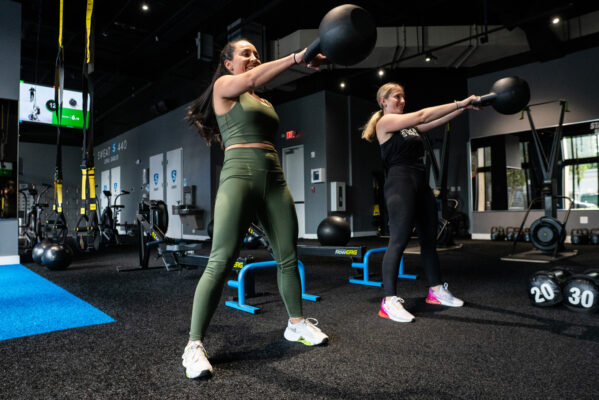
The most effective complement to Pilates is progressive strength training.
That doesn’t mean long, exhausting workouts. It means a focused approach that challenges your muscles in ways Pilates can’t.
A simple, balanced approach might include:
- 2–3 strength sessions per week
- Movements like squats, lunges, presses, rows, and hinges
- Gradually increasing resistance over time
Many people find that a mix like:
- 2 days Pilates + 2 days strength
- or 3 days strength + 2 days Pilates
feels sustainable and delivers the best results.
Is Pilates Good for Strength?
Pilates is perfect for strength, especially when it comes to core strength, control, and endurance.
But if full-body strength is your goal, Pilates works best as part of a bigger picture. When you pair it with progressive strength training, you get the benefits of both: better movement and measurable strength gains.
Ready to build real, full-body strength? Book a Free Strength-Focused Class at SWEAT440 and experience how smart resistance training complements everything Pilates already does well.
FAQ
Is Pilates good for strength training?
Yes, especially for core strength and muscular endurance, but it has limits for long-term strength growth.
Is Pilates enough for full-body strength?
For most people, no. It works best when combined with resistance training.
Can Pilates replace strength training?
Pilates can complement strength training, but it doesn’t fully replace the benefits of progressive resistance.
What should I add to Pilates to get stronger?
Structured strength training 2–3 times per week is the most effective addition.
Biography
 Matthew Miller has over 20 years of experience in the fitness industry as a business owner and personal trainer. He holds a BA in Exercise and Sports Science from the University of North Carolina and is CSCS certified through the NSCA. He is currently the co-founder and Chief Brand Officer of SWEAT440.